



Our resident vet Vicky Payne believes in a holistic approach. Here, she explains exactly what that means…
Holistic, in a veterinary sense, means the assessment and treatment of the whole patient, including behaviour and environmental factors rather than focusing just on symptoms.
I would argue that most good general practice vets take a fairly holistic approach to their patients. It is usual to ask about a dog’s diet and lifestyle, activity and behaviour at annual health check appointments, as well as when an animal is ill. Because our patients can’t talk, vets tend to ask a lot of questions and examine the whole dog during a consultation.
Holistic vets will usually extend this into offering a wider range of treatment options, too. But a holistic approach doesn’t mean abandoning conventional diagnostic, preventative, or treatment options. And most holistic vets choose complementary therapies backed by research.

Vaccinations
Sometimes people are surprised that I am a strong supporter of vaccination. I have worked with vets who saw the devastating emergence of parvovirus in the late 1970s, watched distemper take down a strong mixed breed farm dog, cared for parvo puppies as it has never totally gone away, and barrier nursed (put in place strong measures to stop spread of infection) dogs suffering from leptospirosis. Vaccination hugely reduces the risk of these conditions both for individual dogs and for the population as a whole.
Some pet guardians are very concerned about the risks from vaccines, and because they stimulate the immune system dog can have reactions from mild to life threatening. Reactions are rare, but where owners are concerned, I have some options.
Taco, a Chihuahua, was overdue his vaccinations as a littermate had a suspected reaction, but he needed to go to a dog sitter. I suggested that we could do a blood test to see if Taco needed a booster of his DHP vaccination, and he did not. Leptospirosis vaccination has to be given every year and we can’t test for protection levels and as Taco enjoyed exploring streams and the park, he was at risk. After discussions, we decided to give Taco a herbal tonic to support a healthy immune response for a week before and after his vaccinations. Taco now has annual titre testing, as well as his lepto vaccine, and remains very healthy.
Pain management
Pain management is a big part of my caseload and is an area where most vets accept a multi-modal approach is essential. For Blue, a 10-year-old Labrador with hip dysplasia, I suggested changes to his home to improve his mobility. He was slipping on the tile floors, but rugs soon fixed that and a new supportive bed made sleeping and getting up easier.
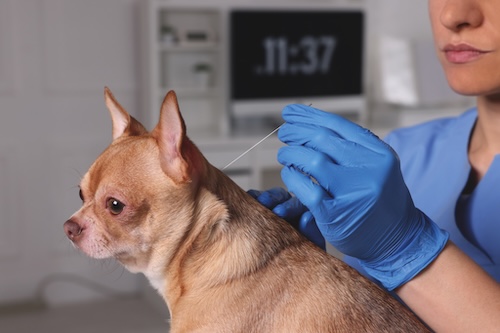
Blue had been on conventional pain killers for a while but was still very stiff. Acupuncture helped with the muscle spasms and added extra pain relief, and we discussed which supplements were useful and which were wasting money. Within a few weeks, Blue was moving more freely and was able to do the exercises his physio had advised. Our next step is to see if he can stay active on a lower dose of medication.
Schnauzer Tilly came to me as a referral from her primary care vet as she had been diagnosed with Cushing’s disease but became very unwell on the treatment. Although herbal medicines are rarely as potent as conventional drugs, some do contain compounds that work in a similar way. I was able to make up a tonic containing herbs shown to support liver function, stabilise blood sugar, support pituitary function, and regulate Tilly’s hormones. Although this tonic did not get Tilly’s blood values into the normal range, it did reduce her symptoms to a manageable level and improved her quality of life.

A holistic view
Taking a holistic view really helps with complicated cases. I recently saw a dog for a behaviour assessment as she had started food guarding, but a look at her medical history suggested an underlying medical cause. She is also a picky eater, does the prayer stretched position often, and suddenly leaps up from lying on her owner’s lap. She had a severe case of haemorrhagic diarrhoea before her behaviour changes began and I now suspect she has chronic gut pain. We will use a brand-new test for gut inflammation and gut biome testing and then use a combination of diet, herbs, pre and probiotics, and conventional medications to improve her gut health. Just doing behaviour modification would probably not have helped this dog.
There are a small, but growing, number of holistic vets, and many more who are adding nutritional medicine, herbal medicine, acupuncture, and other complementary therapies to their tool box. Often taking a step back and looking at the whole dog, as well as their environment and lifestyle, gets better results than just focusing on symptoms.